The Problem
The bar was not designed for you.
The kite bar, as it is generally known and understood by the community today was already established by the mid-2000s : depower mainline, trim, safety leash, complete quick release, line untwist… That combination has been the standard ever since. Honestly, it has everything you need (IMO sometimes even features that result a bad trade off) but one thing. Two decades of refinements have improved the materials, the safety releases, the aesthetics, untwist systems… But the fundamental architecture has not changed.
That architecture has one core limitation. It shows up differently across riders, kites, and conditions — but it is always the same root cause.
How the conventional bar works
The bar’s travel through the depower rope is how the rider manages power moment2moment. The trim sets the baseline: it adjusts where in that travel the kite sits in its target power range.
The trim changes the line differential but also limits the kite’s full potential both in power and steering.Pull the trim in and the sweet spot comes closer — the kite delivers less at full sheet in and depowers more when the bar is pushed away. Every trim adjustment is a compromise.
So the trim has a structural and suboptimal architecture it cannot move past.
The fixed ceiling
The fully sheeted-in position does not move. It is fixed by the geometry of the harness hook and the chicken loop. No matter how you trim, that ceiling stays exactly where it is.
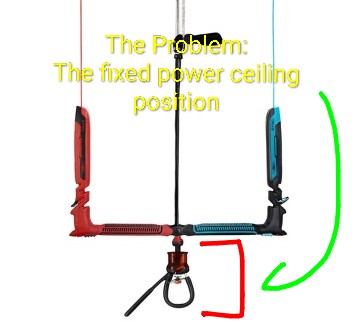
Activating the trim costs you something else that is related to how the power ceiling is fixed while all the things listed below change, forcing the rider to adjust, bearing the cost of having a fixed full sheet in position: rider’s body shape and size/rider’s style preferences/kite shape and size/wind conditions/spots…
At the edges of the power range, the body pays. In light wind the rider is constantly pulling the bar all the way to the chicken loop just to maintain power — arms bent, elbows pulled back, held there for an entire session. In too much wind the arms are overextended pushing the bar away, uncomfortable and unsustainable. Neither position is where the bar’s geometry intended the rider to be. The bar doesn’t adapt to the condition. The body does.
Smaller riders lose the depower range when they need it most. With arms already extended to find the sweet spot, there is nothing left to push. The depower rope’s travel exists on paper. In high power conditions, it is out of reach.
A bigger kite needs more depower rope. Moving through the same angle of attack — from full power to full depower — requires more bar travel on a larger kite than a smaller one. The depower rope needs to be longer to cover that range. But mainstream bars face two constraints simultaneously: the fixed ceiling limits how far you can sheet in, and the limited depower rope length limits how far you can push away. The rider runs out of travel at both ends before the kite runs out of range. Manufacturers intuited part of this — larger kites often ship with a longer depower rope and a smaller chicken loop. The intuition is correct. The solution is partial.
Wave riders face both problems at once. Pulling the trim to manage power costs kite responsiveness at exactly the moment precision matters most. And a shorter depower rope limits how far the bar can be pushed — the kite keeps pulling against the turn when the rider needs it out of the way. The Click Bar addresses the floor problem. The ceiling remains.
In gusty conditions, the system demands constant management. In stable wind the rider sets the trim and rides. In gusty or shifting conditions they are constantly pulling in for gusts, releasing for lulls — and every adjustment costs kite potential. The bar penalises adaptation most in the conditions where adaptation matters most.
The trim’s position constrains the depower rope length. On bars where the trim sits above the depower rope, the rope cannot be made longer than what allows the rider to still reach the trim with arms extended. The trim doesn’t shorten the rope mechanically — but its position sets a hard limit on how long the rope can be. On bars where the trim sits below the power ceiling, trimming does shorten the depower rope directly.
What most riders don’t realise: having the trim above and a fixed power ceiling below is two problems compounding each other. The fixed ceiling limits how far you can sheet in. The trim’s position limits how much depower rope you can have. The available power window — from fully sheeted in to fully depowered — is being squeezed from both ends simultaneously.
What the industry did instead
The industry’s answer has been options: different bar lengths, different chicken loop sizes, longer depower ropes for specific kite sizes. These are sensible refinements within the existing architecture. They do not change the architecture.
The fixed ceiling remains. The trim remains the only mid-ride adjustment. And the core compromise — sweet spot position versus full kite potential — remains baked into every bar produced by every major manufacturer.
There is a better architecture. It starts with moving the ceiling.

